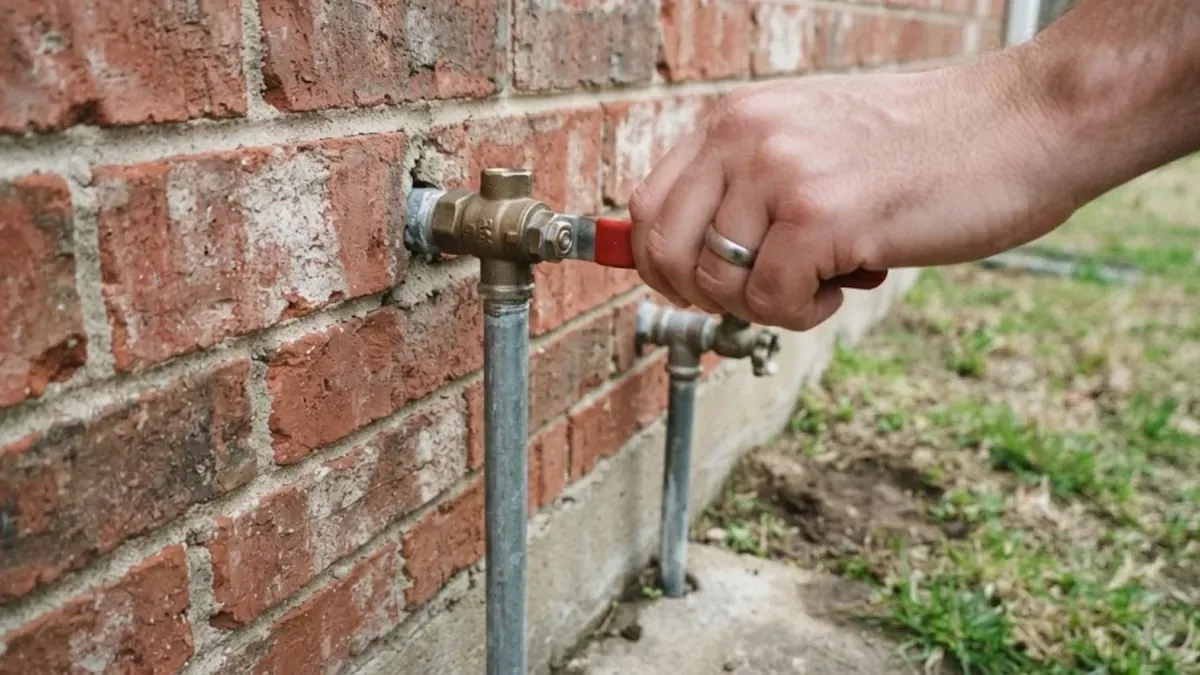
Know Which Kind You Have
A standard hose bib has a short valve right at the wall. A frost-proof hose bib has a long stem, often six to twelve inches, that carries the shutoff deep into the warm part of the house. Look at the faucet from the side. If it tilts slightly downward, it is probably frost-proof, since the angle lets water drain out when it is shut off.
Knowing which kind you have helps you fix it. A frost-proof bib has a stem and a washer at the end of the stem, deep inside the wall. A standard bib has its washer near the handle.
Dripping at the Spout
A drip from the spout when the faucet is off usually means a worn washer or a damaged seat. Turn off the water to the faucet if there is a shutoff inside the house. Unscrew the packing nut, pull out the stem and replace the washer. If the seat is pitted, a new faucet is easier.
Leaking at the Handle
Water that seeps around the handle when the faucet is on points to worn packing or a loose packing nut. Tighten the nut a quarter turn. If that does not stop the leak, replace the packing washer or the O-ring.
Leaking Behind the Wall
This is the problem to catch early. A frost-proof bib that was left with a hose attached through a freeze can crack inside the wall. The crack is invisible until you turn the water on, and then water sprays inside the wall and shows as a stain, soft siding or a spinning water meter.
- Wet or stained drywall near the faucet inside.
- Damp siding or peeling paint around the faucet.
- A water meter that moves when everything is off.
- A hiss or gush inside the wall when the faucet is on.
- Moss or mold on the wall below the faucet.
If you suspect a hidden leak, shut off the water to that line and call. Our leak detection service can confirm the source without opening the wall more than needed.
Faucet Leaking Outside?
Call and describe the leak. A plumber can often come the same day.
Repair or Replace
| Symptom | Likely cause | Fix |
|---|---|---|
| Drip from the spout | Worn washer or seat | Replace washer, or the faucet |
| Leak at the handle | Worn packing | Tighten or replace packing |
| Leak inside the wall | Cracked stem or body | Replace the faucet |
| No water or weak flow | Closed shutoff, debris or a split pipe | Check the shutoff, then call |
| Handle will not turn | Corrosion | Replace the faucet |
A replacement frost-proof bib is a straightforward job in many walls. It may involve soldering on copper pipe or a push fitting on PEX. If the wall is brick or the pipe is hard to reach, a plumber saves you a damaged wall. Our faucet repair page covers indoor and outdoor models.
Moncks Corner Notes
Moncks Corner usually has mild winters, but the record low is 11 degrees Fahrenheit. A rare hard freeze catches many homes unprepared. Disconnect hoses before a freeze, since a hose holds water against the faucet and prevents the stem from draining.
The town also gets about 52 inches of rain a year, so a bib that leaks behind the wall can stay damp long enough to rot sheathing. Checking the wall inside a garage or closet each season takes a minute.
How to Protect an Outdoor Faucet
- Disconnect hoses and splitters before cold nights.
- Install a frost-proof bib on new work.
- Add a foam insulating cover on nights near freezing.
- Close and drain any indoor shutoff for the line in cold snaps.
- Know where the main shutoff is, in case a pipe splits.
If a pipe does split, shut off the water and call. Our burst pipe repair page explains the emergency steps. Homes near Goose Creek can reach us through the Goose Creek page.
Backflow Preventers and Vacuum Breakers
Many hose bibs have a small vacuum breaker on the spout. It keeps water in a hose from flowing back into the house supply. If it leaks from a hole in the side when the faucet is on, that is normal for some designs. If it drips constantly, replace it.
Choosing a Replacement Outdoor Faucet
Match the pipe connection to your plumbing. Sweat fittings solder onto copper. Push fittings connect copper, PEX or CPVC without a torch. Threaded fittings screw on. The length of the stem must also match the thickness of the wall, so measure from the outside face of the siding to the inside of the wall.
Look for an anti-siphon model with a built-in vacuum breaker. It prevents water in a hose from flowing back into the house supply, which matters if you use a sprayer for fertilizer or pesticides.
A Quick Seasonal Check
Once a season, open the faucet, attach a hose and look at the wall inside while the water runs. Check for dampness, stains or a hissing sound. Then remove the hose and look at the spout for drips. A two-minute check can catch a leak long before it rots the wall.
When the Problem Is the Pipe, Not the Faucet
If a new faucet still leaks behind the wall, the supply pipe or its fitting may be damaged. Low water pressure at the faucet, or water that comes out of the siding, points the same way. A plumber can test the pipe, locate the break and repair it without removing more wall than necessary.
Standards and Sources
Hose bibs commonly carry a vacuum breaker because the International Plumbing Code (IPC) requires protection against backflow into the house supply.
What to Do If the Wall Is Wet
- Close the shutoff for that line or the main valve.
- Take photos of the stain and the meter reading.
- Open the faucet to drain the pipe.
- Keep electrical outlets near the wet wall off until it is checked.
- Call a plumber before closing up the wall.
Outdoor Faucet Repair Questions
A worn washer or damaged seat is the usual cause. Replacing the washer, or the faucet, stops it.
It has a long stem and tilts slightly downward. Look from the side, or check inside the wall if you can reach it.
Yes. A cracked stem can spray inside the wall. Watch for stains, soft siding or a moving water meter.
Hard freezes are rare, but not unknown. Disconnect hoses and consider insulating covers on the coldest nights.
On accessible copper or PEX it is doable. In tight walls or with unusual pipe, hire a plumber.
A simple washer or packing job takes minutes. A replacement takes longer, especially in finished walls.